


Scalping trading strategies: a comprehensive guide for active traders

Imagine you’re at a farmers’ market. You're not trying to buy a whole farm. You’re just buying a handful of apples at a time. You buy them slightly below the market price and then sell them slightly above it. You do this all day long to make a small profit on each sale. These small profits add up over time. This is similar to a scalp trading strategy. Scalping is a high-speed trading style. The goal is to make very small profits by placing many trades throughout the day. The strategy focuses on tiny price changes, where the trader enters and exits positions quickly. This can happen in minutes or even seconds.
Remember, while technical indicators and short-term trading strategies can offer insights into price movement, past performance is not a reliable indicator of future results.
What is scalping in trading?
The basic principle of scalping in trading is to make many small gains through the day by taking advantage of minor price movements. You don’t wait for a major trend or hold positions overnight. Scalpers believe that small price moves are easier to predict. They also believe they are more frequent than large ones. That’s why they try to accumulate these small profits so that they add up by the end of the day and outweigh any losses made.
So, what’s the difference when it comes to scalping vs day trading? Day trading also involves closing all positions by the end of the day. But day traders hold positions from minutes to hours. They aim for larger profits per trade. Swing traders hold positions for days or weeks. They try to capture larger market trends. Scalpers hold positions for seconds to minutes. Their profit per trade is very small and their trade frequency is very high.
Scalpers use very short timeframes, using 1-minute, 5-minute, or tick charts. A tick chart shows every single trade. They can make dozens or hundreds of trades each day. This high frequency is what makes scalping unique.
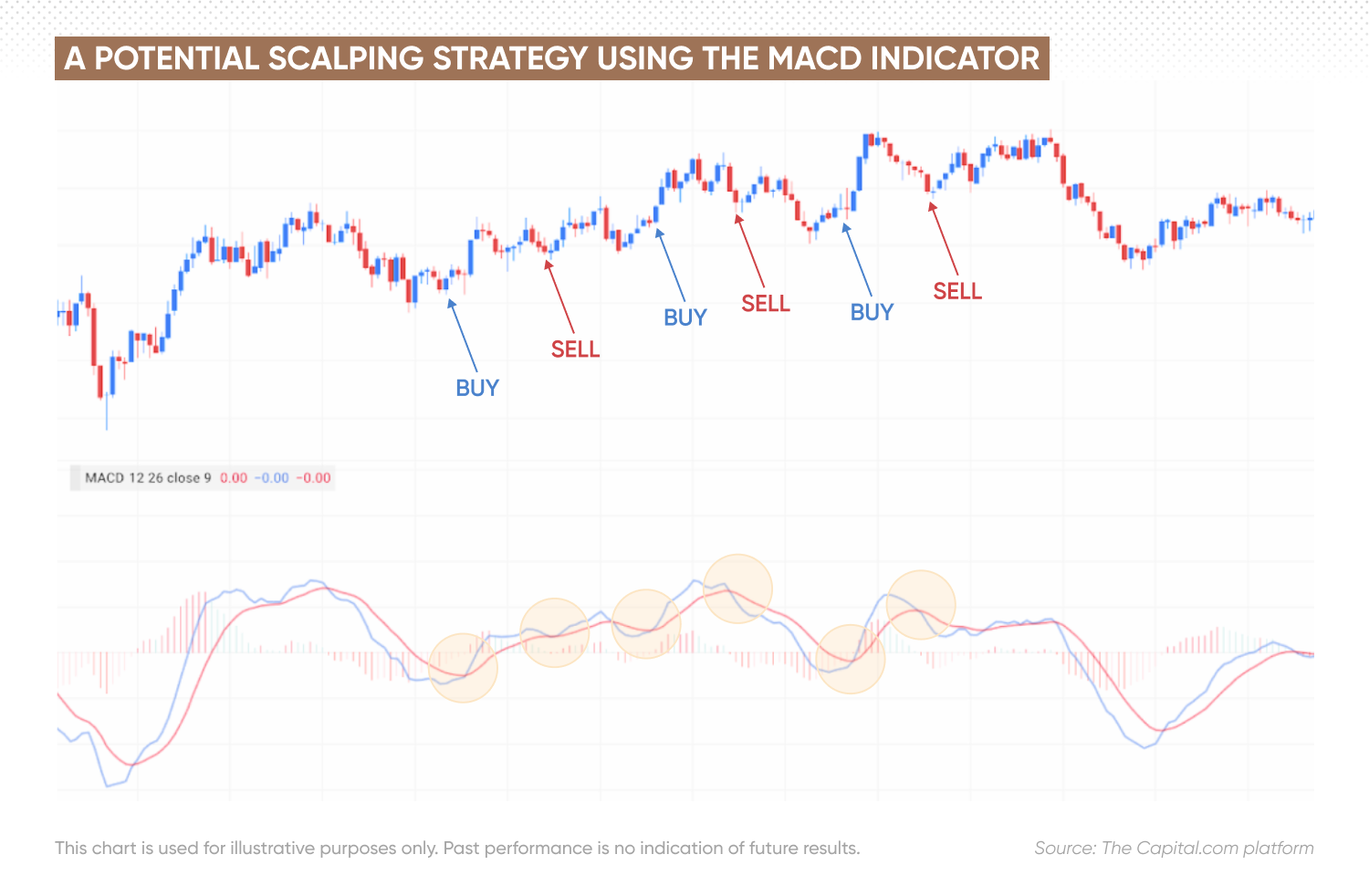
Past performance is not a reliable indicator of future results.
How scalping works in the markets
Scalping relies on micro price movements. These are the smallest changes in an asset’s price. For a scalp trading strategy, liquidity is key. High liquidity means many buyers and sellers are active. This allows traders to enter and exit positions quickly. A scalper needs to get in and out without causing a major price shift.
The bid-ask spread is very important in this strategy. It is the difference between the highest price a buyer is willing to pay (the bid) and the lowest price a seller is willing to accept (the ask). Scalpers need very tight spreads, since wide spreads eat into profits. Imagine the spread is 5¢. If a scalper buys at the ask and sells at the bid, they instantly lose 5¢. They must overcome this cost to be profitable.
Finally, scalpers need fast execution. They often use specialised software to identify and enter trades quickly.
Let’s understand scalping with an example. Suppose a scalper identifies a stock at $10.00. The bid is $10.00 and the ask is $10.01. The scalper buys 1000 shares at $10.01. A few seconds later, the price ticks up. The bid becomes $10.02. The scalper immediately sells all 1000 shares. They make a $0.01 profit per share. This is a total profit of $10. This process is repeated many times. These small profits add up.
Want to practice scalping for beginners without risking real money? Open a demo account.
Types of scalping strategies
To choose from the best scalping strategies, you must learn the techniques used in each strategy.
Breakout scalping
This strategy focuses on price breakouts. A breakout happens when the price moves above a resistance level or below a support level. Scalpers try to enter a trade right at the start of the breakout. They exit as soon as the initial momentum fades.
Timeframe: 1-minute to 5-minute charts
Best markets: volatile stocks and crypto
Momentum scalping
This strategy rides a strong price movement. Scalpers look for stocks with high volume and fast price changes. They jump in on a strong candle and ride the momentum for a few ticks. They get out before the momentum stops.
Timeframe: 1-minute charts
Best markets: high-volume stocks, forex, and crypto
Range scalping
This strategy is for markets with no clear trend. The price moves between a support and resistance level. Scalpers buy at the support level and sell at the resistance level. They do the opposite when the price is at resistance.
Timeframe: 5-minute charts
Best markets: forex pairs during low volatility periods
Pullback scalping
A pullback is a temporary dip in an uptrend or a temporary rise in a downtrend. Scalpers look for a strong trend and then wait for a small pullback. They enter the trade in the direction of the main trend and exit quickly as the trend resumes.
Timeframe: 1-minute charts
Best markets: any trending market
Moving average ribbon strategy
This strategy uses a group of moving averages, called a ‘ribbon.’ When the ribbon expands, it signals strong momentum. Scalpers use the ribbon to confirm the trend direction. They enter a trade when the price moves above or below the ribbon.
Timeframe: 5-minute charts
Best markets: forex, stocks
Price action & volatility scalping
This involves trading based on price charts alone. No indicators are used. The trader reads chart patterns and candle formations. They combine this with high volatility. High volatility creates bigger price swings and provides more opportunities for a scalper.
Timeframe: 1-minute charts
Best markets: crypto, futures
Learn more about different trading strategies to find what suits you the best.
Top scalping indicators
Scalpers often use indicators to find trade setups. Some of the most popular scalping indicators are:
Moving averages
These are simple lines that smooth out price data. Scalpers use them to identify trends. For a 1-minute scalping strategy, a trader might use a fast moving average (such as 5-period) and a slow one (such as 20-period). A buy signal occurs when the fast moving average crosses above the slow one.
Bollinger bands
This is a volatility indicator, and consists of a middle band (a moving average) and two outer bands. The outer bands expand during high volatility and contract during low volatility. Scalpers buy when the price touches the lower band and sell when the price touches the upper band. The most popular settings are 20-period and 2 standard deviations.
RSI and MACD
The relative strength index (RSI) measures momentum. It shows whether a market is overbought or oversold. Moving average convergence divergence (MACD) shows the relationship between two moving averages. A scalper can use RSI to confirm a trade. For example, a buy signal on the MACD is stronger if the RSI is also low.
VWAP
Volume weighted average price (VWAP) shows the average price of an asset. This is weighted by volume. It is a key indicator for many scalpers. They use it as a dynamic support or resistance level. A scalper might buy when the price is below the VWAP and sell when it crosses above.
Stochastic oscillator
This scalping indicator compares a closing price to a price range. It can show overbought or oversold conditions. Scalpers use it to find entry points. A buy signal occurs when the stochastic lines cross in the oversold area (below 20).
Volume-based tools
Volume is a key indicator for scalpers. High volume confirms strong price moves. Scalpers look for volume spikes. They use these spikes to confirm a breakout or a new trend. Volume profile and order flow tools are also used.
Scalping in different markets
A scalp trading strategy can be applied to many markets. Of course, the approach changes slightly for each. Here’s a look.
Forex
Forex scalping techniques are very popular. The forex market is open 24/5, with many currency pairs enjoying high liquidity. Plus, if you are margin trading, the leverage available allows for large positions. This means small price moves can lead to larger profits. But be careful with leverage, since it also magnifies losses.
Stocks
Stock scalping requires high-volume stocks. Low-volume stocks have wide spreads, which makes them unsuitable for scalping. Scalpers in the stock market often focus on large, well-known companies. They also use news trading and earnings reports to scalp stocks.
Crypto
The crypto market is highly volatile. This makes it attractive for scalpers. Price swings are often much larger than in forex or stocks. But crypto trading can have higher fees and more slippage.
Futures
Futures are standardised contracts. This can be a benefit for scalpers. They offer high liquidity and low transaction costs. They are also traded with leverage. This makes them a popular choice for scalpers.
The core principles remain the same, since scalping adapts across instruments. The scalper always looks for small price moves. The adaptation comes in the details. For forex, the trader might focus on a few major pairs. For stocks, they might use a scanner to find volatile stocks.
Learn more about trading different asset classes with market guides.
Trading tools for scalpers
Scalpers use different tools to improve trading.
Order types
Scalpers primarily use market orders and limit orders. A market order executes instantly at the best available price. A limit order is an order to buy or sell at a specific price or better. Scalpers also use stop-limit orders for risk management.
Essential features
Fast execution is a must. A scalper’s platform must have low latency. This means a very short delay between the trader’s order placement and its execution. One-click trading is a huge advantage.
Charting tools and layouts
A scalper’s setup often includes multiple screens. One screen for the trading platform, and other screens for charts and market data. They use clean, fast charts. They prefer simple layouts and often have charts of different timeframes open at once.
Risk management in scalping
Risk management is crucial in scalping, since a single mistake can wipe out many small gains.
Tight stop losses are a must
A stop loss is an order to sell when the asset price reaches a predetermined level. It is used to limit losses. Scalpers use very tight stop losses. This means the stop loss is very close to the entry price. If a trade goes against them, they can get out fast. A 1-2¢ loss is better than a 10¢ loss.
Risk/reward ratio
The typical risk/reward ratio is skewed. Scalpers risk a small amount to make an even smaller amount. For example, a scalper might risk $1 to make $0.50. This is an unusual ratio. The high win rate is what makes it profitable. They might win 8 out of 10 trades, so that the gains are more than the losses.
Managing slippage and transaction costs
Slippage is when an order is filled at a different price than intended. It can happen in fast-moving markets. Transaction costs (commissions, spreads, etc.) are also a big factor. They can eat into profits. Scalpers choose brokers with low costs.
Capital allocation and leverage
Scalpers use a small amount of their total capital per trade. For example, they might risk only 0.1% of their account. But they often use high leverage. Leverage lets them control a large position with a small amount of capital. But it also increases risk, as mentioned earlier.
Learn more about risk management before applying your scalp trading strategy.
Scalp trading considerations
Separate from the pros and cons, there are a number of things traders could want to consider if they wish to explore scalping.
Order execution
A delayed or bad order can wipe out profits, so mastering the art of order execution is a key part of scalp trading.
Frequency and costs
Frequent buying and selling can be costly and add up in terms of spread cost, which can cause profits to drop.
Trends
Trends and the cyclical nature of the markets can be helpful for scalpers. Knowing when to enter and exit a trade, and repeating a pattern could be helpful to a novice scalper.
Technical analysis
Understanding the basics of technical analysis may be useful when scalping. Certain technical indicators are intended for very small time frames, and can be helpful when looking at short-term opportunities, or multiple chart scalping.
Discipline
As a rule, most scalpers close all positions during a day’s trading session and tend not to carry them onto the next day. Scalping is based on taking advantage of the small opportunities that exist in the market.
Psychology of scalping
Your trading psyche plays an important role in scalping. The speed and frequency of trades can cause stress. Decisions must be made in seconds. There is no time for deep thought. This requires the ability to handle high-speed decisions, a high level of focus, and a pre-defined plan.
The constant pressure can be stressful. A scalper must be disciplined. Build a plan and stick to it. This keeps emotions out of decision-making. Also, if a loss makes you emotional, it is time for a break from trading.
Greed and fear are major enemies. A trader might get greedy and hold a position too long. This can turn a small gain into a loss. On the other hand, they might get scared after a loss and hesitate on the next trade. This can make them miss a winning opportunity.
Scalping can be exhausting. It’s not a 9-to-5 job. It requires breaks. Scalpers need to know when to step away from the screen to prevent burnout.
Building a scalping routine
Setting a routine is vital for success. The first step is to create a trade plan. This is your roadmap. It defines the strategy and lists the entry and exit rules. It also sets risk management rules. A scalper must have a plan before they start trading.
A trading journal helps you track your performance and improve. It helps you learn from mistakes and shows what is working and what isn’t. A scalper tracks their win rate and average profit per trade to identify patterns.
The best time to scalp is during high liquidity periods. For forex, this is when two major sessions, such as the London and New York sessions, overlap. For stocks, this is the first hour after the market opens.
The routine should also include a review session. The scalper looks at their trading journal to analyse their performance. They then make small changes to their strategy to improve it.
Pros and cons of scalping
The advantages of a scalp trading strategy include the frequent opportunities provided by small price movements. Also, since positions are held for a short time, exposure is low. This reduces the risk of large, unexpected moves. Small price changes are more frequent than large trends.
Among the limitations of this trading style is the stress caused by the high speed and frequency of trading. Plus, transaction costs add up very fast. It isn’t a strategy for beginners without practice. It is better suited for those with experience.
Learn more about trading psychology to understand whether scalping is suitable for you.
Common mistakes and how to avoid them
One of the most common mistakes in scalping is overtrading. A trader might enter trades that don’t fit the plan in hopes of making profits. The solution is to stick to your plan. Chasing late entries is another mistake to avoid. You might see a price move and jump in too late, just before the price reverses. The solution is to wait for the next setup.
Ignoring transaction costs should also be avoided. Costs can be a killer. Calculate the costs of each trade to ensure that your average profit is higher. Lack of risk management can lead to losses. Not using a stop loss or using a stop loss that is too wide is a big mistake.
Finally, make sure you don’t try strategy hopping: this is when a trader switches strategies constantly. They try one thing for a day, and then another. They never master one strategy. The solution is to pick one strategy and practice it until you master it.
Scalping for beginners: how to get started
Scalping isn’t for everyone. Beginners must practice scalping on a demo account first. This way, you get to use virtual money to master the strategy.
In addition, read books and articles on scalping. Watch videos from successful scalpers and learn from others. But always remember to test everything yourself on a demo account. The goal is to build a skill, not just to follow a guru. Start small. Learn from your mistakes. Be patient.

