

Spreads
The spread is the difference between the buy and sell price of an asset. It is the primary way Capital·com generates revenue. The size varies depending on the asset and market conditions.
In highly liquid markets such as EUR/USD or gold, spreads are typically lower than in less liquid markets. Less liquid markets may carry higher costs and greater volatility.
The spread on the deal ticket before opening a position shows the exact cost at that moment.
CFD spread example
- 1 contract is held on the US Tech 100, quoted at 12475/76.
- The spread is 1 point.
- Half the spread is paid on opening and half on closing. The total spread cost is £1 x 1 point = £1.
Guaranteed stop-loss orders
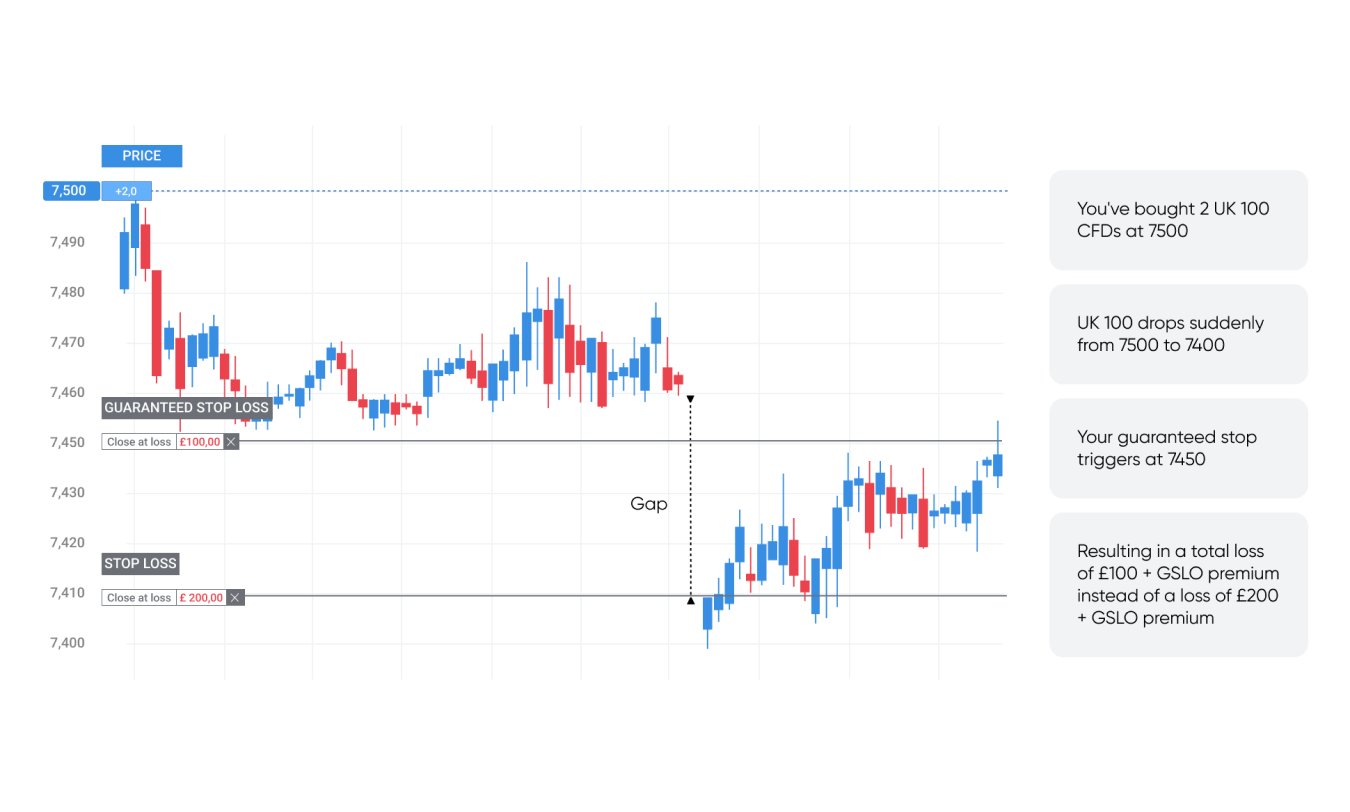
A standard stop-loss order closes a position at a specified level. It is not guaranteed to execute at exactly that price — during a market gap, execution may occur at the next available price. Slippage can occur in volatile or low-liquidity conditions.
A guaranteed stop-loss order (GSL) closes a position at exactly the specified price, regardless of slippage or market gaps. A fee — the GSL premium — applies if the order is triggered.
Overnight funding
Overnight funding is a daily charge applied to leveraged positions held past the daily rollover time. It reflects the cost of maintaining exposure outside standard market hours. In some cases — typically for short positions — a credit is applied rather than a charge.
The calculation varies by asset class:
- Indices and shares: relevant interest rate benchmark (such as SONIA or SOFR) plus Capital·com's daily fee.
- Forex: underlying market adjustment (TomNext), plus or minus Capital·com's daily fee.
- Commodities: underlying market adjustment (futures basis), plus or minus Capital·com's daily fee.
- Bonds/interest rates: underlying market adjustment (futures basis) plus or minus Capital.com's daily fee (0.01096%).
- Cryptocurrencies (Bitcoin and Ethereum CFDs): fixed daily rates apply. Long positions: 0.06164% daily (22.5% annually). Short positions receive a credit of 0.0137% daily (5% annually).
More information is available on the Charges and fees page.
Currency conversion fee
Applies when a transaction is in a different currency to the account's base currency. The fee is built into the exchange rate used for the conversion — not charged separately. Clients pay a 0.7% mark-up.
Applies to:
- Realised profit and loss
- Overnight funding adjustments
- Guaranteed stop-loss order fees
- Dividends
- Standalone currency conversions (manual conversions of account balance)
Example — closing a trade
- Account currency: USD. European stock trade closed with a profit of €10.00.
- At spot rate (1.1300): $11.30
- At all-in rate including 0.7% fee (1.1221): $11.22
- Conversion fee: $0.08
Example — overnight funding adjustment
- European stock position. Overnight funding adjustment of -€4.00 applied in EUR.
- At spot rate (1.1300): $4.52
- At all-in rate including 0.7% fee (1.1379): $4.55
- Conversion fee: $0.03
The all-in exchange rate used for each conversion is visible in the Reports section and when closing a position.


